

Episode 4: "The Gibson Murder Case" premiered on Oct. 1, 2020
An attempted blackmail scheme by a criminal couple goes south when the target threatens to call the police. When his corpse is discovered in the upstairs apartment of a quirky young school teacher, Richard Diamond is engaged to solve the case.
Written by Blake Edwards and Transcribed by Fred Matzner Directed by Doug Bost Sound Design & Engineering - David Margolin Lawson Musical Direction - Keith Burton PSA Written by James Bosley
CAST (in order of appearance):
ANNOUNCER – Martin Collins
RICHARD DIAMOND – Rik Walter
VIRGINIA AUSTIN – Elizabeth Bell
HARVEY AUSTIN – Joe Burby
LELAND GIBSON – Doug Bost
HELEN ASHER – Laura Fois
ESTHER BLODGETT – Nikaury Rodriguez
SGT. OTIS – Ken Dillon
LT. WALT LEVINSON - Jeff Ward
MISS GIBSON – Elizabeth Bell
ADAMS HOTEL CLERK – Jeff Ward
LANDLADY – Laura Fois
PSA Announcer – Peter Flihan
Episode Three: "The Thomas Jason Case" premiered Sept. 22nd.
A retired stockbroker suspects that his stepdaughter is trying to kill him. He employs Richard Diamond to investigate. But when the stockbroker suddenly goes missing, Diamond suspects foul play, and uncovers a sinister scheme inside… an insane asylum.
Written by Blake Edwards and Transcribed by Fred Matzner Directed by Gregory Wolfe Sound Design & Engineering - David Margolin Lawson Musical Direction - Keith Burton PSA Written by James Bosley
CAST (in order of appearance):
ANNOUNCER - Martin Collins
THOMAS JASON - Joe Burby
RICHARD DIAMOND - Rik Walter
HELEN ASHER - Laura Fois
SGT. OTIS - Ken Dillon
LT. WALT LEVINSON - Jeff Ward
CAROL JASON - Nina Mehta
BRAZZO - Gregory Wolfe
DR. THORNE - Steven Martin
PSA ANNOUNCER: Peter Flihan
Episode Two: "The Isham House Mystery" premiered on Sept. 15, 2020
A dead millionaire with a lousy sense of humor is haunting his widow to force her to give up her inheritance. Richard Diamond is employed to spend the night in her house. Hidden passages, basement crypts, and creepy butlers make for…a dark and stormy night.
Written by Blake Edwards and Transcribed by Fred Matzner Directed by Doug Bost Sound Design & Engineering - David Margolin Lawson Musical Direction - Keith Burton
CAST (in order of appearance):
ANNOUNCER - Martin Collins RICHARD DIAMOND - Rik Walter JULIA ISHAM - Lisa Karlin SGT. OTIS - Ken Dillon LT. WALT LEVINSON - Jeff Ward KANE - Victor Verhaeghe GHOST - Doug Bost. PSA ANNOUNCER: Peter Flihan HELEN ASHER - Laura Fois
UP Presents "Richard Diamond Private Detective" Sept. 8, 15, 22, 29, 2020
For the first time UP is producing Radio Plays, presenting 4 episodes of the 1949 series “Richard Diamond Private Detective.” Written by Blake Edwards and starring Dick Powell, these nostalgic pieces are a fun return to a simpler time.
Episode One, “The Betty Moran Case” will premiere on Sept. 8th: (click on the link at the top of the page to listen in on our YouTube Channel)
The double murder of a rich socialite and a blackmailing thug lead the police to think it a murder/suicide. But the grieving husband wants to get justice for his dead wife and so he pays a visit to the offices of Richard Diamond.
Written by Blake Edwards and Transcribed by Fred Matzner Directed by Gregory Wolfe Sound Design & Engineering - David Margolin Lawson Musical Direction - Keith Burton
CAST: (in order of appearance)
ANNOUNCER - Martin Collins RICHARD DIAMOND - Rik Walter BETTY MORAN - Connie Castanzo MAC GRAYSON - Gregory Wolfe NEWSBOY - Deirdre Cipolla LOUIE OSGOOD - Ken Dillon WILLIAM MORAN - Ax Norman SGT. OTIS - Ken Dillon LT. WALT LEVINSON - Jeff Ward WILBUR TRUETT - James Bosley PSA ANNOUNCER: Peter Flihan FACTORY WORKER - James Bosley FRANCIS - Gregory Wolfe HELEN ASHER - Laura Fois
“Richard Diamond, Private Detective” Radio Series is Produced by UP Theater Company, and made possible by the generous support of: Lower Manhattan Cultural Council and the Upper Manhattan Empowerment Zone

Announcing our "Renewal Reading Series" - Call for submissions!
We here at UP lament the postponement of Lizzie Donahue's A BARN PLAY. We are committed to its production during our 2020-21 season. We find some solace in knowing that our play was only one of countless productions from around the world that were cut short, postponed, or canceled outright.
In the interest of honoring new works that were on the cusp of taking their next step before outside forces intervened, UP is issuing a call for scripts of new plays whose readings, workshops, or productions were impacted by the Coronavirus. We will select up to eight plays to present as readings during our 2020-21 season.
We are calling this series "Renewal" - the opposite of "canceled - and we hope to breathe new life into this work.
Click HERE for submission guidelines
To say that these are uncertain times feels trite. So we will instead say that we will get through them and that we look forward to seeing you on the other side.
A Barn Play: Postponed until 2021

Graphic Design by Ellen Lindner
A Barn Play by Lizzie Donahue directed by Melissa Moschitto
Lizzie Donahue interview, February 25th 2020:
https://aszym.blogspot.com/2020/02/i-interview-playwrights-part-1073.html
Dead of Winter 2020
4 Cold Saturdays! 4 hot readings. An annual exploratory reading event, of plays in differing levels of development.
January 4th- Bastard
Written & directed by Seth McNeill
Two brothers attend a wake for their mother. Or is it their father? The woman who may or may not be their sister knows the answer. Or does she? Maybe the only thing real is the longing for connection.
January 11th- The Best Punk Band in Conway, Missouri: An Oral History of Presley Cox and the Fallout Five
By Kirby Fields, directed by Rachel Murray
An older punk rocker looks back at the hard knocks and glory days and the band that propelled her to fame, sort of.
January 18th- Mr. Theater
By Doug Bost, directed by Ashley O’ Neill
A comedy about an octogenarian moves to New York- and onto his son’s couch- and tries to make it as a serious actor.
January 25th- Drown
By David Hilder, directed by Amanda Joshi
A teenage boy attempts to cope with his mom’s suicide by drowning, while his mom tries to cope with her new life under the sea.

Summer Heat Reading Series 2018
Ah, Wilderness!
by Eugene O’Neill
directed by James Bosley
A comic look at the playwright’s own coming of age, in politics and in love, over an eventful 4th of July weekend.

Ah, Wilderness!
by Eugene O’Neill
directed by James Bosley
A comic look at the playwright’s own coming of age, in politics and in love, over an eventful 4th of July weekend.
FREE TO THE PUBLIC
Saturday, June 30th
4pm in Isham Park
Enter Isham Park at the circle on Park Terrace East, near Bruce’s Garden
Bring a blanket or lawn chair
Summer Heat Reading Series is presented as part of the
Northern Manhattan Arts Alliance’s Uptown Arts Stroll
and with support from
Partnerships for Parks’ Inwood Parks Grant
Made Possible by Columbia University
presented by special arrangement with SAMUEL FRENCH, INC
Detained: Q&A
DETAINED director NANCY ROBILLARD (L) and playwright ROSE-MARY HARRINGTON take a few questions from UP’s artistic director James Bosley about this timely new play.

DETAINED director NANCY ROBILLARD (L) and playwright ROSE-MARY HARRINGTON take a few questions from UP’s artistic director James Bosley about this timely new play.
JAMES: Rose-Mary, what drew you to this story?
ROSE-MARY: I was compelled to write Detained in 2008 after I learned of the plight of asylum seeking families who were being incarcerated in a former penitentiary in Texas. Children along with their parents were treated as criminals. The families fled persecution and violence and threats in their home countries seeking refuge in the United States of America. When they were apprehended at the border they were shipped to Hutto, a privately-run family detention center in Texas. In Hutto they were stripped of belongings, men and women were separated, and children over seven years old confined to their own cells. Hutto was run like a prison—with counts, laser trip wires, and meager mental and physical stimulation for the children. Even stuffed toys were banned. As Captain Viv, one of the facilitators laments, “America is better than this.” I hope this play serves as a voice for those who do not have a voice. I never imagined how topical immigration would become ten years from the inception of Detained.
JAMES: Nancy, what was your first impression when you initially read the play?
NANCY: When I read the play for the first time, I realized that I had a knot in my chest the entire time I was reading it. That was a good thing—it meant I’d been deeply moved by it. I felt for the characters and the situation they are in—being in detention, their futures uncertain. Some have been there a long time, with no end in sight. I wanted to be part of telling their story.
JAMES: Rose-Mary, we’ve had a lot of back and forth on the script, including a staged reading, since you sent it to us three years ago. Was there a moment during that process that really helped clarify the story for you? Was there a moment that was especially painful?
ROSE-MARY: From the staged reading in 2016 it became apparent that I needed to develop a central character. This became Maria, a teen caught in the crossfire of immigration. She is smart, endearing, and recognizable as any kid struggling with adolescence, and with her relationship with her mother. Maria now gives the play focus and cohesiveness. The moment that was especially painful to write, and now to witness in rehearsal, is at the conclusion of the play. It is heart-breaking to watch a teen so despondent due to the suffocating circumstance she finds herself in this play.
JAMES: What draws you to doing new plays?
NANCY: Working with the playwright is a privilege and a luxury. It is great to be able to ask the writer. “Is this what you meant here?” Rose-Mary lives in South Carolina and flew up here to be with us for the first week of rehearsal. The cast and I spent that week with her sitting around a table, reading and analyzing scenes. She made script changes every day based on what she learned from the rehearsals. As we are staging the play, we continue to discover things about the script—what is working and what is not. Rose-Mary has joined us sometimes by Skype or Face-Time so that she can watch rehearsals and continue to make adjustments in the text. At times a writer is inspired to re-write because of something specific an actor or director has done. Other times it happens simply because we have put the play up on its feet. The writer can see it and say. “Now I know how to fix the ending.” (It is almost always the ending.) So we really learn what is working and what is not. Then we bring in the audience and learn about the play from them. It is thrilling to be part of that process, and I truly appreciate UP Theater for giving us the opportunity. It is no small feat for a theater company to produce new plays, and UP does it beautifully.
Detained in the Press
UP’s been in the press with the announcement of our next production, Detained.

UP’s been in the press with the announcement of our next production, Detained.
Broadway World // UP Theater Company Announces Cast of DETAINED
“In 2006, the Department of Homeland Security opened the first family detention center for undocumented immigrants – at a former prison in Texas, surrounded by razor wire fencing and operated by the nation’s largest for-profit corrections company. None of the detainees have criminal records, yet they are treated as if they do. They’re required to wear orange prison jump suits. Their meals, recreation, and family time are rigorously regulated. Their communication with the outside world is strictly limited. There is no privacy.” Read more.
Theater Mania // Casting Announced for World Premiere of Detained
“In Detained, Doug and Maria, teenagers from different lands, forge an alliance to help each other’s families survive incarceration and escape deportation. In the face of oppression and humiliation, the teenagers unite against a deeply fractured system in their fight for freedom.” Read more
Dead of Winter 2018
4 COLD SUNDAYS | 4 HOT PLAYS
*FREE ADMISSION*

4 Cold SUNDAYS | 4 Hot Plays
*FREE Admission*
Sunday, January 7
The War Party
by Vincent Delaney
directed by Don Stephenson
with
Odelia Avadi, Jennifer Piech, William Youmans
In the wake of a devastating election loss, two women – the defeated candidate and a young volunteer – engage in a charged cat and mouse game, and the ghost of FDR plays along. It’s a parable about the limitations of the two-party system.
Sunday, January 14
Faculty Portrait
by Sean DeMers
directed by Ariel Francoeur
A year after a school shooting claimed the life of his wife, Mr. Y finds himself teaching in the same classroom where the tragedy occurred. While being interviewed for the school yearbook by students tied to the event, they attempt to make peace with the ghosts of the past.
Sunday, January 21
The Insidious Impact of Anton
by David Hilder
Francesca knows what’s what and who’s who and where they should stick everything… until she meets a peculiar fellow who is much more than he seems.
Sunday, January 28
Mike & Roma
by Anna Cascio
directed by Molly Fowler
Mike and Roma say they don’t regret not having children, but when a baby is left on their doorstep they begin to sing a different tune. The only question now is, What song will they sing?
LOST/NOT FOUND: The Reviews Are In!
“Funny and entertaining. Riveting…”
Jamie Saunders, Devin E. Haqq, Max Lebow

“This was incredible. This is the type of theater that I live for.”
Mariette Strauss, Max Lebow

“I am willing to see 10 Bad Plays in a row if it means I get to see a hidden gem like this every once in a while.
Max Lebow, Andrew Manning, Jamie Saunders
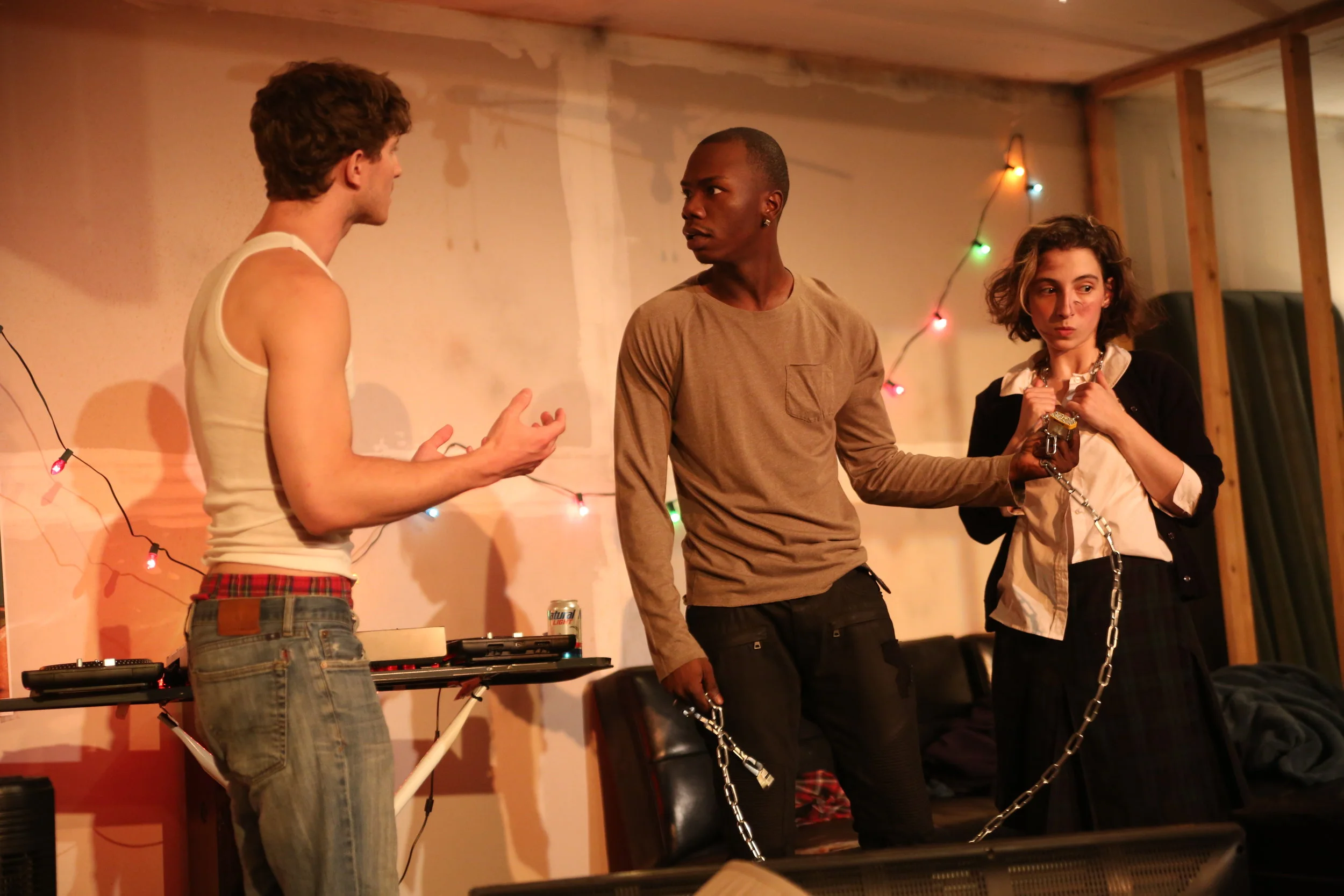
“…extremely well executed”
Set by Frank Oliva. Lighting by Duane Pagano. Costumes by Janet Mervin.
“…the set was perfect.”

Read all the reviews at SHOW SCORE.
LOST/NOT FOUND: Construction of the Set
Don’t miss this time-lapse footage of the set construction.
LOST/NOT FOUND: Q&A
Director Alex Keegan and playwright Kirby Fields take a few questions from UP’s artistic director James Bosley about this vital new play, Lost/Not Found.

Director Alex Keegan (L) and playwright Kirby Fields take a few questions from UP’s artistic director James Bosley about this vital new play, Lost/Not Found.
Kirby, a lot has changed in the world since you showed us the first draft of Lost/Not Found in the summer of 2014. As you’ve re-written it for this production, have you done so with an ear on current events? And does the play resonate in ways that it didn’t back when you began it?
KIRBY: The script has evolved in a way that it probably would have no matter who had won the election. However, I do think themes have emerged throughout the process that have taken on a different sense of urgency in light of the country’s shifting dynamics. An audience member who had seen the draft that preceded the November election might have walked away thinking that the play was concerned with affordable housing in New York City, which would have been a fair takeaway. Given the scope of challenges that the country currently faces, however, that probably won’t be at the fore of someone’s mind who sees the play now. At the risk of being presumptuous, an audience member who sees the current version is more likely to interpret it on a national scale, as a portrayal of an entire subset of the population that is being, at best, ignored and, at worst, discarded.

Alex, you and Kirby have worked together before when you directed his comedy, Steal This Play. Can you identify any quirks or tendencies common to both that we might call “Kirby-esque?”
ALEX: Kirby has a knack for dialogue, especially fun, comedic banter that’s underscored by something far more intimate or sinister. When I first read Lost/Not Found I was stifling laughter while also absolutely distressed about the situations the characters found themselves in. We had a conversation early on about the characters’ likability. The characters in this play, as in Steal This Play, are complex and often drawn to unethical choices, yet they are also charming, which creates a dilemma for an audience. On the one hand, we’re aware that much of what the characters are doing is ethically questionable; on the other hand, we like them and understand the circumstances that brought them to these choices. In this way, he invites audiences into their world without prescribing judgment. He also writes with an incredibly specific tone that’s fun to capture in the staging.

Kirby, you live in Washington Heights, the neighborhood where the play takes place, and blocks away from where it will be performed. Does that put an extra spring in your step now as you walk down Broadway?
KIRBY: Of course I have extra pep in my step going to and from rehearsal. On some nights I’m even able to have dinner with my wife and kids beforehand. Frank Oliva, our set designer extraordinaire, also lives uptown, and he mentioned that he has never had an opportunity to work on a show that he can walk to. And, yes, the play itself is very much rooted in the neighborhood. The GW Bridge and the Little Red Lighthouse play a big part. La Marina gets a veiled shout-out, and the characters live on 187th Street. Meanwhile, we are rehearsing at a church on the corner of 181st and Ft. Washington, and even changed a line to reference a certain pizzeria across the street. But the best part is blasting out invites to friends who live in the area: “Come see UP’s new show. You have to cross exactly one street and you’re there!”
Alex, your career focuses almost exclusively on new work. Why so?
ALEX: I enjoy the challenge of building the world in which the playwright’s narrative and characters will first live. I often find myself asking of new plays questions like – why does the scene proceed? Why doesn’t she leave in this moment? Of course you can ask the same questions of classics, but there’s an immediacy to interrogating new work that I find thrilling. When we find the answers to these “whys” in rehearsal—when a re-write provides clarity, or we sort out a character’s narrative arc, and all of us fully understand why these characters stay on stage together, why the scene proceeds—there’s something triumphant about it, that moment when a new play clicks.
LOST/NOT FOUND: Early Press
With less than three weeks to go until the opening night of Kirby Fields’s LOST/NOT FOUND, the press is starting to pick up on UP’s spring production.

The cast of “Lost/Not Found” (L-R): Mariette Strauss, Max Lebow, Jamie Saunders, Devin E. Haqq (not pictured: Andrew Manning).
With less than three weeks to go until the opening night of Kirby Fields’s LOST/NOT FOUND, the press is starting to pick up on UP’s spring production.
Broadway World has a sneak peek of the cast here.
Stage Buddy has an event page all lined up.
And Uptown Collective has all the info on LOST/NOT FOUND here. (And while you’re there, check out their glowing review of EPIC POETRY.)
LOST/NOT FOUND by Kirby Fields, directed by Alex Keegan, opens Wednesday, May 3 at 8:00PM at The Garret at Fort Washington Collegiate.
Onward & UPward: Meeting Manny Ramirez
“From an early age Manny understood the importance of the words ‘we’ and ‘us’ and that our neighborhood is strengthened by everyone’s participation. He developed Dichter Pharmacy into an Inwood institution with exhibitions, performances and soda shop with free meeting space. His unbridled support of Inwood and its arts and culture make Manny a most deserving recipient of the UPstanding Person of the Year award.”
— Martin Collins (Community Leader, and UPstanding Person of the Year ’16)

“From an early age Manny understood the importance of the words ‘we’ and ‘us’ and that our neighborhood is strengthened by everyone’s participation. He developed Dichter Pharmacy into an Inwood institution with exhibitions, performances and soda shop with free meeting space. His unbridled support of Inwood and its arts and culture make Manny a most deserving recipient of the UPstanding Person of the Year award.”
— Martin Collins (Community Leader, and UPstanding Person of the Year ’16)

Without a space to call their own, Rabbi Herschel Hartz and the congregation of Inwood Jews found a home at Dichter to observe the Sabbath. — “I am committed to growing the Jewish community. When I was growing up, everyone was mixing with everyone.”
“Low-key yet indispensable, Manny is the poster-boy for what Inwood is about – small-town Americana at the tip of Manhattan. His basement space is booked daily with community groups of every type, his walls are adorned with paintings and photos by Uptown Artists, and his lunch counter is our village cafe where we share news, opinions, and poems. And his grilled cheese is a New York classic.”
— James Bosley (Artistic Director, UP Theater Company)

Manny came back strong from the 2012 fire, rebuilding an expanded store on the same block, and never forgot the community that supported him. — “The fire was a terrible thing that ended up being a really good thing. I not only owe the bank but I owe the neighborhood because when I needed them they showed up.”
“Manny is one of the most energetic and creative business owners supporting arts and culture in Inwood. His contributions of time, space, and resources come not only from a place of wanting to do good – he is sincerely passionate about art in its many forms, and wants to share that passion with the community.”
— James Waldo (Founder, Listen Closely Inwood Chamber Music Initiative)

Manny hosting a candle-light vigil for residents in support of victims of the Orlando massacre. — “I felt compelled, as a business owner in Inwood, that I had to do something. We’re about healing and love.”
Local groups benefiting from free Dichter community space:
Preschool on the Planet — 34th Precinct Community Group — Listen Closely chamber concerts — Spanish, French & Arabic language classes — Inwood Jews — Mother Goose Story-time — The Girl Scouts — Lactation Consultant — Many book-readings & exhibits of local artists — UP Theater Company

Manny speaking to Manhattan Bridges High School students engaging in the study of work and professional choices in the real world. — “I get to know you, know your family situation and that’s just the first facet of what we do as a business. To say we’re part of the community and that’s important to me.”
MERCIFUL FATHER: Q&A
Merciful Father playwright Atar Hadari (L) and director James Bosley were asked a few questions about this vital new play.
Merciful Father playwright Atar Hadari (L) and director James Bosley were asked a few questions about this vital new play.
James, as the Artistic Director of UP, what was it about Merciful Father that made you think this was an UP play?
JB: We get a lot of plays submitted to UP, some good, some not so good. But it’s unusual to get one that truly startles me. Merciful Father did so with its bold disregard of form and genre, while at the same time telling a kickass story about a sinner trying to shield his daughter from shame by turning, somewhat naively, to religion. And though the play contains this misguided religious quest, God, in the end, plays the role of antagonist–dramaturgically speaking. And I thought that thrilling and juicy and perfectly UP-esque.
Atar, you describe the play as “loosely adapted” from God of Vengeance by Sholem Asch. How much did you change for Merciful Father?
AH: Sholem Asch did not have the opportunity to write about phone sex, and having that opportunity a hundred years later, I embraced it! I also thought his original ending of throwing a Torah scroll on the floor would no longer shock a Jewish audience, let alone a non-Jewish one, so I followed the play to what I thought was its logical conclusion.
James, you are first and foremost a playwright. What made you want to direct this play?
JB: Scenes veer from farce to sitcom to melodrama to operatic tragedy. Thinking about it later, I realized that what I saw as flaws were actually an ingenious way of expressing a reality that unfolds for us in a complex, almost comical series of diverse experiences. Suddenly I saw the whole concept before my eyes, and became very jazzed to direct it. But first I had to make sure Atar was on board with my concept, which thankfully he is.
Atar, what is it about this almost 100-year old play that made you want to adapt it for a modern audience?
AH: I was asked to adapt the Sholem Asch play, which I didn’t know. To be perfectly honest, it was a play about a brothel, which was something I knew nothing about. But I was actually living at the time in North Manchester, the biggest ultra-Orthodox Jewish community in Europe, and passed a newsagent window one day where I saw a card advertising for phone sex workers. The notion of a phone sex business in the midst of this very upright neighborhood stayed with me.
James, can you tell us about your concept for the play?
JB: No, I don’t want to spoil the surprise. Well okay, just a peak behind the curtain then. To heighten the play’s theatricality, we are presenting it as though it is a skit in a down-and-out Music Hall. So we are constructing a theater environment that reads “cheesy theater” and the evening will include–AT NO EXTRA CHARGE–pre-play performances to introduce that concept to the audience (the play itself is short anyway, under an hour). But then, as the play progresses… No I shan’t reveal anymore!
Atar, you are UP’s first international playwright. How did you find us all the way from Manchester, England and what made you think we were the right company for your play?
AH: By day I am a mild-mannered bible translator living in a sleepy but picturesque village in England. By night I subscribe to a NYC Playwrights list where one day an add caught my eye, largely because a friend of mine used to live in your neighborhood, in Inwood: “UP is not afraid to be gritty, rambunctious, irreverent. We do not favor camp or sitcom. Looking for plays that relate to and challenge an urban working class audience. Comedy or drama. We like them juicy.” I can’t say after all this time but I suspect it was “we like them juicy” that did it.
UP Announces its 2016-2017 Season!
Find out what’s coming UP!
Fall 2016
“Merciful Father” by Atar Hadari
November 1st – 12th
All shows at 8PM
Fort Washington Collegiate Church (729 West 181st Street)
A brothel owner commissions the creation of a Torah scroll to win a respectable husband for his daughter. His daughter instead chooses ill repute. Based on the scandalous Yiddish play “God of Vengeance” by Sholem Asch.
Spring 2017
“Lost/Not Found” by Kirby Fields
May 2017
After a successful Drama Shop presentation last November, UP is pleased to present a full production of this play by “K Comma Joseph” playwright Kirby Fields. Three desperate twenty-somethings from Washington Heights “rescue” a missing autistic girl and detain her, while the growing reward for her return offers visions of riches. What they learn about themselves, however, may prove to be the more valuable bounty.
And of course our season would not be complete without:
- “Onward & Upward” Annual Benefit
- Showing UP artists’ salons
- Dead of Winter Reading Series
AN AMERICAN DRUM CIRCLE: The Audience Talks Back
“Thoughtful treatment of a tough situation we don’t generally stop to consider; a very talented cast…brilliant tech (lights/sound/set) make for a terrific theater-in-the-round experience Uptown. Go see this play!” – Liz Ritter

“Thoughtful treatment of a tough situation we don’t generally stop to consider; a very talented cast…brilliant tech (lights/sound/set) make for a terrific theater-in-the-round experience Uptown. Go see this play!” – Liz Ritter

“…superb acting …smartly written …provoked a lengthy after-show conversation.” – Julia Attaway

“An American Drum Circle tackles the issues of faith, hope, deception and race in a deep and at times very humorous production… The cast is talented, the story is rich and the production values are solid.” – Eddie Antar
AN AMERICAN DRUM CIRCLE: Q&A
A Conversation with Vanessa Shealy & Melissa Attebery
A Conversation with Vanessa Shealy & Melissa Attebery
UP: Oklahoma, Church, Hip-Hop, Africa… Vanessa, why did you want to write a story that brings these worlds together?
Vanessa: I’m originally from Oklahoma, grew up in church, am in an interracial marriage, and have lived through many of the struggles in this play. So really this story is about the diverse people and experiences of my world coming together. It was very exciting to write characters from a variety of different backgrounds. I relied heavily upon the input of the racially diverse actors and other artists, who, over the years, have been gracious and bold enough to share their insight into the world of this play.
UP: Which character was the most difficult to write?
Vanessa: Ironically, probably Mandy, since she’s closest to me. While the play isn’t strictly autobiographical, it is heavily based on real struggles and situations that I’ve lived through. There isn’t a single character in the play that isn’t at least influenced by an important person in my life. So it was a real wake up call to find that the character who is most similar to me was the difficult one for me to write. Probably need to take that up with a therapist.
Melissa: That’s interesting to hear you say that because one of the biggest ways the play has changed has been the development of Mandy as the central character. As we’ve worked together on a series of female character-driven plays, often developed in a traditional setting, we learned that, as women, we tell stories differently and that people receive stories with female characters differently than those with men.
UP: Melissa, this is the first time UP is producing a play staged “in-the-round”. Did you begin the process with a clear vision of how you would stage the play or are you letting it unfold?
Melissa: There are strong cues and explicit notes written into the script about how it moves and what it looks like. The biggest challenge to realizing the vision has been breaking out of the habits formed by the number of presentational staged readings we’ve done. But even still, the play and I both were literally bursting at the seams to throw down the music stands and live. My instinct to do it in the round grew from discussions about the title of the play, and [set designer, Duane Pagano’s] idea of a mega church altar helped solidify the idea.
UP: You two have worked together on many projects over the years, including An American Drum Circle. How is that history reflected in the rehearsal room?
Vanessa: I started writing scenes for this play around seven years ago when Melissa and I were working together in the Playwright and Director Workshop at the Actors Studio. We can speak in a kind of shorthand together now–which we frequently do over large glasses of wine after rehearsals.
Melissa: We’ve been working on this for so long, so many of the questions that we would actually ask each other in the rehearsal room have already been asked. We obviously talk about the play independently of each other all the time, but what I find interesting is that often, anything asked of us is something we’ve already discussed, and we often tag team an answer.